
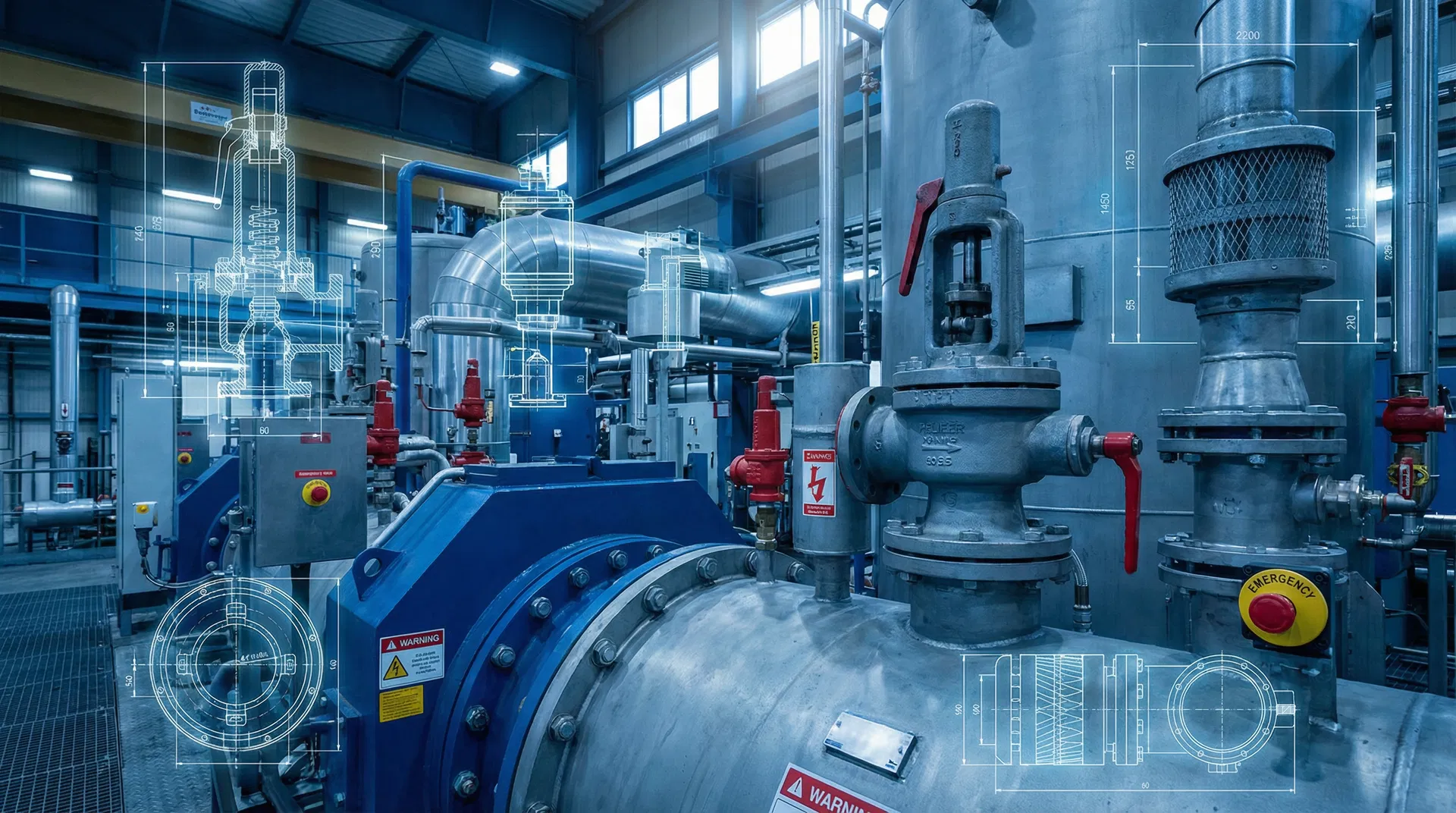
Equipment Explosion Protection Engineering Design Logic from NFPA Standards
Equipment Explosion Protection: Not Choosing One, But Building a System
In the field of industrial explosion protection, a common misconception is: choosing one explosion protection method is enough. In fact, mature equipment explosion protection engineering design follows a four-layer protection mechanism — venting, suppression, isolation, and control — each layer having its irreplaceable role.
The NFPA (National Fire Protection Association) series of standards provides a complete technical framework for these four mechanisms. Understanding the internal logic of these standards is a prerequisite for making correct engineering decisions.
Overview of NFPA Standard System
| Standard | Core Content | Application Scenarios |
|---|---|---|
| NFPA 68 | Deflagration Venting Guide | Explosion vent panels, vent duct design |
| NFPA 69 | Explosion Prevention Systems | Inerting, suppression, isolation systems |
| NFPA 654 | Dust Explosion Prevention | Combustible dust handling equipment |
| NFPA 652 | Combustible Dust Fundamentals | Dust explosion risk assessment |
| NFPA 61 | Agricultural Dust | Grain processing facilities |
Detailed Analysis of Four-Layer Protection Mechanism
First Layer: Venting
Core Standard: NFPA 68
Venting is the most basic and widely applied explosion protection measure. Its principle is: pre-set weak points (explosion vent panels) on equipment or buildings. When internal deflagration occurs, pressure is released through these weak points in a safe direction, preventing structural damage to equipment or buildings.
NFPA 68 provides a complete formula system for calculating vent area. Engineers need to calculate based on the following parameters:
- Equipment volume (V)
- Maximum explosion pressure (Pmax)
- Equipment design pressure (Pred)
- Explosion characteristic parameters (KSt or KG)
Engineering Advantages of RSBP Vent Panels: RSBP series explosion vent panels have obtained dual ATEX and FM certifications. While meeting NFPA 68 calculation requirements, they provide more precise vent characteristic curves, enabling engineers to perform more accurate system design.
Second Layer: Suppression
Core Standard: NFPA 69 Chapter 11
Explosion suppression systems detect the pressure or flame signals in the early stages of an explosion at high speed, and spray suppressant into the explosion space within milliseconds, extinguishing the explosion in its early development stage.
Typical system response times:
- Detection to trigger: < 5ms
- Spray completion: < 60ms
- Complete explosion suppression: < 100ms
Third Layer: Isolation
Core Standard: NFPA 69 Chapter 12
Isolation systems prevent explosions from propagating through pipelines, conveying systems, etc. to adjacent equipment, avoiding the "domino effect."
Main isolation methods:
- Mechanical isolation valves: Rapid closure triggered by explosion pressure
- Chemical isolation barriers: Injection of suppressant to form isolation zones
- Rotary valves: Physical blocking of propagation paths
Fourth Layer: Control
Core Standard: NFPA 69 Chapter 6-9
Prevention of explosions by controlling the formation of explosive mixtures, including:
- Inerting: Filling equipment with inert gas to reduce oxygen content below the Limiting Oxygen Concentration (LOC)
- Concentration control: Maintaining combustible concentration below the Lower Explosive Limit (LEL) or above the Upper Explosive Limit (UEL)
- Temperature control: Preventing reaching the auto-ignition temperature
Engineering Practice of RSBP Systems
The RSBP (Rembe Safety + Control) system represented by TKC has corresponding products in all four protection mechanisms:
- Venting: RSBP explosion vent panels (circular/square/rectangular)
- Suppression: RSBP Q-Rohr® explosion suppression system
- Isolation: RSBP EXKOP® isolation valve
- Control: Supporting monitoring and control systems
Key Decision Points in Engineering Design
In actual projects, when choosing protection strategies, consider:
- Explosion characteristic parameters: KSt value determines the intensity of the explosion and directly affects system selection
- Equipment location: Indoor equipment may not be able to use venting (requires vent ducts), while outdoor equipment is more flexible
- Process continuity requirements: Suppression systems need cleaning and reset after triggering, affecting production continuity
- Economics: Initial investment and operation and maintenance costs vary significantly between different solutions
Conclusion
Equipment explosion protection is not about choosing a product, but building an engineering-verified protection system. NFPA standards provide a scientific calculation framework, RSBP products provide certified execution tools, and TKC's engineering team provides the professional capability to combine the two.
Correct explosion protection design starts with understanding the standards.
TKC — Science-based Industrial Safety & Protection
For more technical details or professional assessment, please contact the TKC expert team.