Firestop: It's Not Done When You're Done Filling
A Common Misconception
In most construction projects, firestop is often handled like this:
- Purchase a batch of firestop mortar, boards, and pipe collars
- Have workers fill according to their own understanding
- Pass visual inspection during fire safety acceptance
- Project complete, firestop "done"
This process appears complete but has fundamental flaws: the effectiveness of firestop has never been guaranteed by "looks filled."
DIIM: The Complete Lifecycle of Firestop
International firestop industry standards define the effectiveness management of firestop as a four-phase closed loop:
D — Design
Firestop design is not "choose a material and fill it in," but rather:
- Determine the penetration configuration (substrate material, opening size, penetrant type)
- Select the corresponding certified system (e.g., UL listed system number CAJ-4102)
- Calculate key parameters such as fill depth and annular space
- Produce construction drawings and material lists
Common Errors: Substituting certified materials with "looks similar" materials, or using certified drawings for one configuration to guide construction of a different configuration.
I — Installation
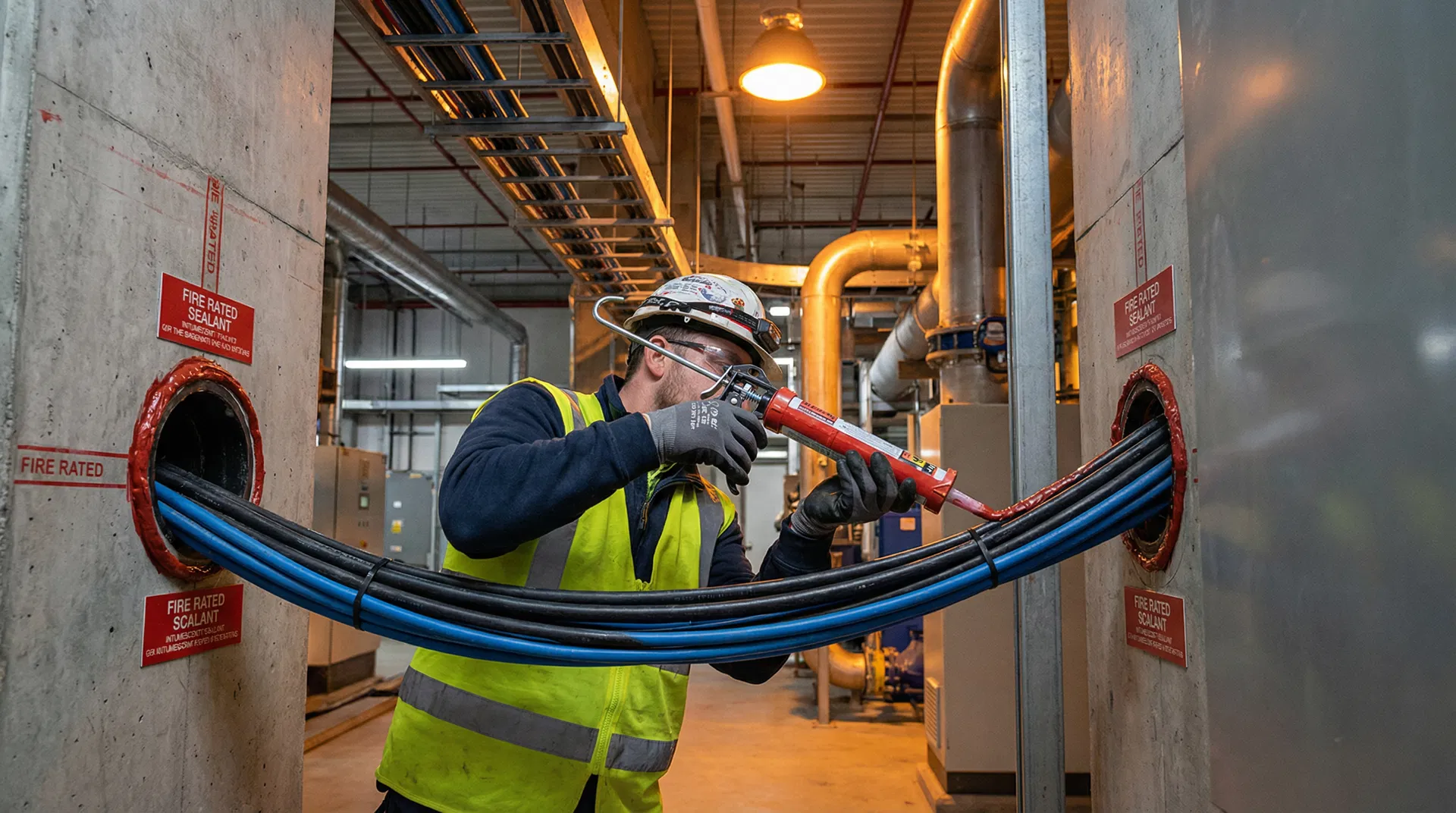
Installation is the phase where firestop most easily goes wrong. Key control points include:
- Annular space: The gap between the penetrant and the opening edge must meet certified drawing requirements
- Fill depth: Different materials have different minimum fill depth requirements
- Wet film thickness: The application thickness of liquid firestop materials must reach specified values
- Substrate preparation: Cleaning and treatment of opening edges affects material adhesion
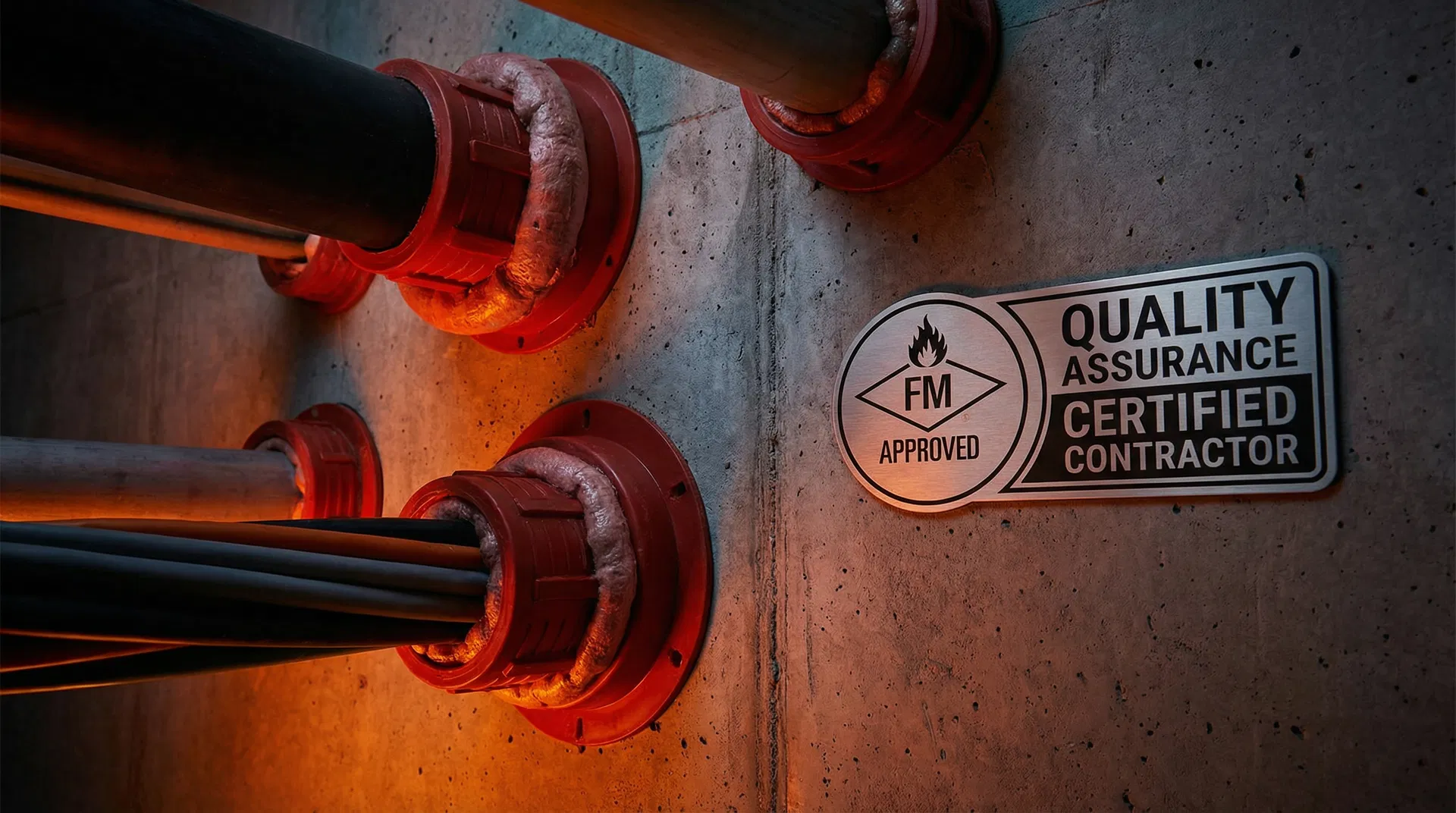
Value of FM 4991 Certification: The DRI system ensures that every seal is installed by personnel who have undergone certified training, not arbitrary workers.
I — Inspection
Completion of construction does not equal acceptance. Effective inspection includes:
- In-process inspection: Real-time recording of key control points
- Final acceptance inspection: Point-by-point verification of "documentation vs. reality consistency"
- Independent third-party inspection: Independent verification by ILAC-certified bodies
Why is third-party inspection needed? Contractor self-inspection has conflicts of interest, and owner internal inspection lacks professional capability. Only independent third-party inspection can truly verify construction quality.
M — Maintenance
Firestop is not a "one-time project." Throughout the building's lifecycle, you need:
- Regular inspections: Identifying aged, damaged, or modified seal points
- Subsequent construction management: Subsequent construction such as adding cables or modifying pipes may damage existing seals
- Record updates: Continuous updating of maintenance documentation
Most common maintenance failure scenario: Subsequent construction (such as adding cables) destroys existing seals without repair, creating permanent fire protection vulnerabilities.
Quantifying the Gap: Qualified Materials vs. Qualified Systems
Here is a comparison of a typical case:
| Scenario | Materials | Method | Result |
|---|---|---|---|
| Scenario A | FM certified materials | Certified method (DRI installation) | System performance meets certification requirements |
| Scenario B | FM certified materials | Non-certified method (ordinary workers) | System performance cannot be guaranteed |
| Scenario C | Non-certified materials | Arbitrary method | System performance completely unknown |
Conclusion: Buying qualified materials doesn't buy a qualified system.
TKC's DIIM Closed-Loop Delivery
TKC provides complete DIIM closed-loop services in firestop projects:
Design Phase: Based on site surveys, select the corresponding FM certified system for each penetration point and produce complete construction drawings.
Installation Phase: Construction led by FM 4991 certified DRI, with real-time recording of key control points.
Inspection Phase: Cooperate with ILAC-certified third-party inspection bodies for independent verification, producing inspection reports that meet international standards.
Maintenance Phase: Provide subsequent inspection services, establish a seal point database, and support full lifecycle management.
Conclusion
The value of firestop lies in whether it can truly function when a fire occurs. And this "whether it can" depends on the complete execution of all four DIIM phases, not just "filled."
Next time you evaluate a firestop project, ask a question: Has this seal been verified through the complete DIIM process?
TKC — Science-based Industrial Safety & Protection
For more technical details or professional assessment, please contact the TKC expert team.
Related Articles
Don't Let Survivorship Bias Blind You — Why Firestop Contractors Must Choose FM Certification
Read More
Building Nuclear Safety Defense Lines: Full Lifecycle Firestop Solutions for Nuclear Power Plants
Read More