
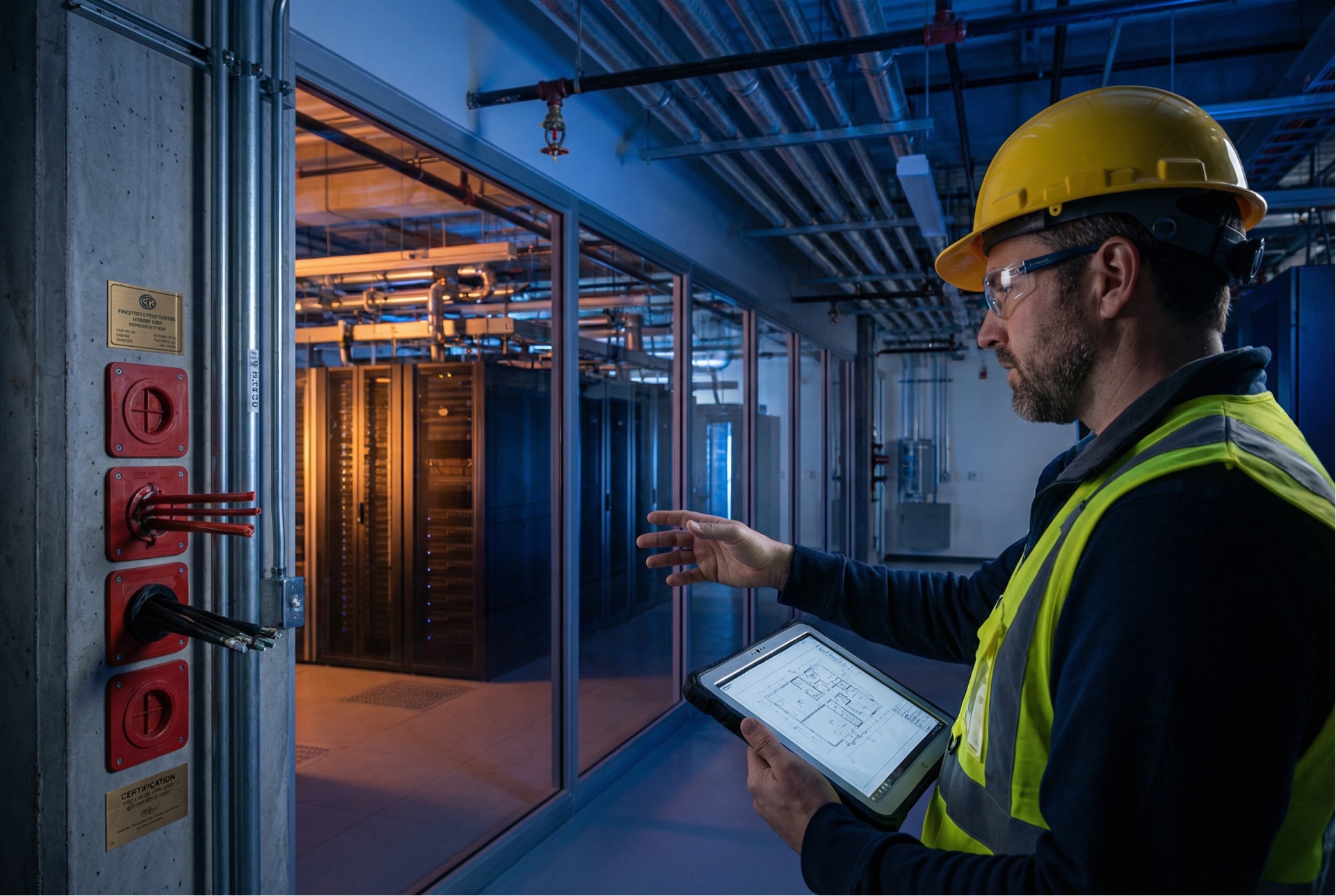
AI Data Centers Need More Than Firestop Materials
As AI Data Centers Expand, Firestopping Cannot Stop at Material Compliance
As AI data-center and large-scale data-center construction accelerates across Southeast Asia—including Singapore, Malaysia, Thailand, Vietnam, and Indonesia—the number of cable-tray, busway, pipe, control-line, and cooling-system wall penetrations is increasing rapidly.
For a data center, the key issue is not only whether a firestop material is compliant. It is whether the entire fire compartment can remain intact through construction, acceptance, and subsequent operations and maintenance.
For AI data-center and large data-center projects, Shanghai Tengxi Construction Engineering Co., Ltd. provides an engineering-led Fire Compartment Integrity Solution.
FM 4991 Certified Firestop Installation
Firestop installation is carried out by an FM 4991 certified firestop contractor in accordance with project requirements. For Cable Tray, Busway, Conduit, Metal Pipe, Plastic Pipe, Mixed Penetration, and other penetration types, the system selection and installation are determined against the applicable FM Approved System, design drawings, and project technical specifications.
The value of firestopping is not simply filling an opening. It lies in consistency between the materials, construction, installation method, and site records.
Selection of FM-Certified Firestop Materials and Systems
According to wall or floor construction, penetrant type, opening size, and required fire rating, a project can match the appropriate FM-certified firestop materials and systems.
Selection and installation should confirm:
- the applicable scope of the materials and system;
- wall, floor, and opening construction conditions;
- penetrant type, quantity, and fill ratio;
- firestop thickness, backing, and installation method; and
- consistency between the certified installation method, project technical specification, and site conditions.
Independent Third-Party Firestop Inspection
Where required by a project, an independent third-party body with the relevant accredited scope and operating within the ILAC MRA recognition framework can inspect the firestop system selection, site installation, material use, firestop thickness, opening size, and installation records, establishing traceable inspection documentation.
Depending on project requirements, the inspection can refer to:
- ASTM E2174;
- ASTM E2393;
- the Approved Firestop System; and
- the Project Specification.
Independent inspection puts design, material, installation, and records into one verifiable evidence chain, providing a clear technical-documentation basis for owners, EHS teams, insurance reviewers, and future maintenance.
Airtightness Testing and Room Integrity Verification
For critical enclosed spaces protected by gaseous fire-suppression systems—such as data halls, electrical rooms, UPS rooms, and control rooms—Room Integrity / Airtightness Testing can be used to verify leakage through the enclosure.
Airtightness issues are often directly associated with:
- cable-tray wall penetrations;
- pipe wall penetrations;
- wall joints;
- door gaps;
- floor openings; and
- firestop defects.
This allows airtightness testing and firestop remediation to form a closed loop:
Test → Locate Leakage → Firestop Remediation → Re-test → Verify
The applicability, test method, and acceptance criteria for airtightness or room-integrity testing must follow the gaseous fire-suppression design, project technical specification, and applicable standards. Firestopping is an important part of fire-compartment management, but should not be described by itself as a guarantee of enclosure retention time.
From “Filling a Hole” to Fire Compartment Integrity Management
Shanghai Tengxi aims to address more than an individual opening. The focus is a complete management chain from design review, FM system selection, and installation to third-party inspection, airtightness testing, and final acceptance documentation:
Design Review → FM System Selection → Firestop Installation → Third-Party Inspection → Airtightness Testing → Final Compliance Documentation
As AI data centers adopt higher power density, liquid-cooling systems, UPS infrastructure, and larger BESS installations, fire-compartment integrity, penetration management, and airtightness performance in critical rooms will become even more important.
Shanghai Tengxi will continue to use international certification frameworks and engineering management practices to support passive fire protection and fire-compartment integrity for Southeast Asian AI data centers, hyperscale data centers, colocation data centers, semiconductor, pharmaceutical, and high-tech facilities.
TKC — Science-based Industrial Safety & Protection
For more technical details or a professional assessment, please contact the TKC expert team.


