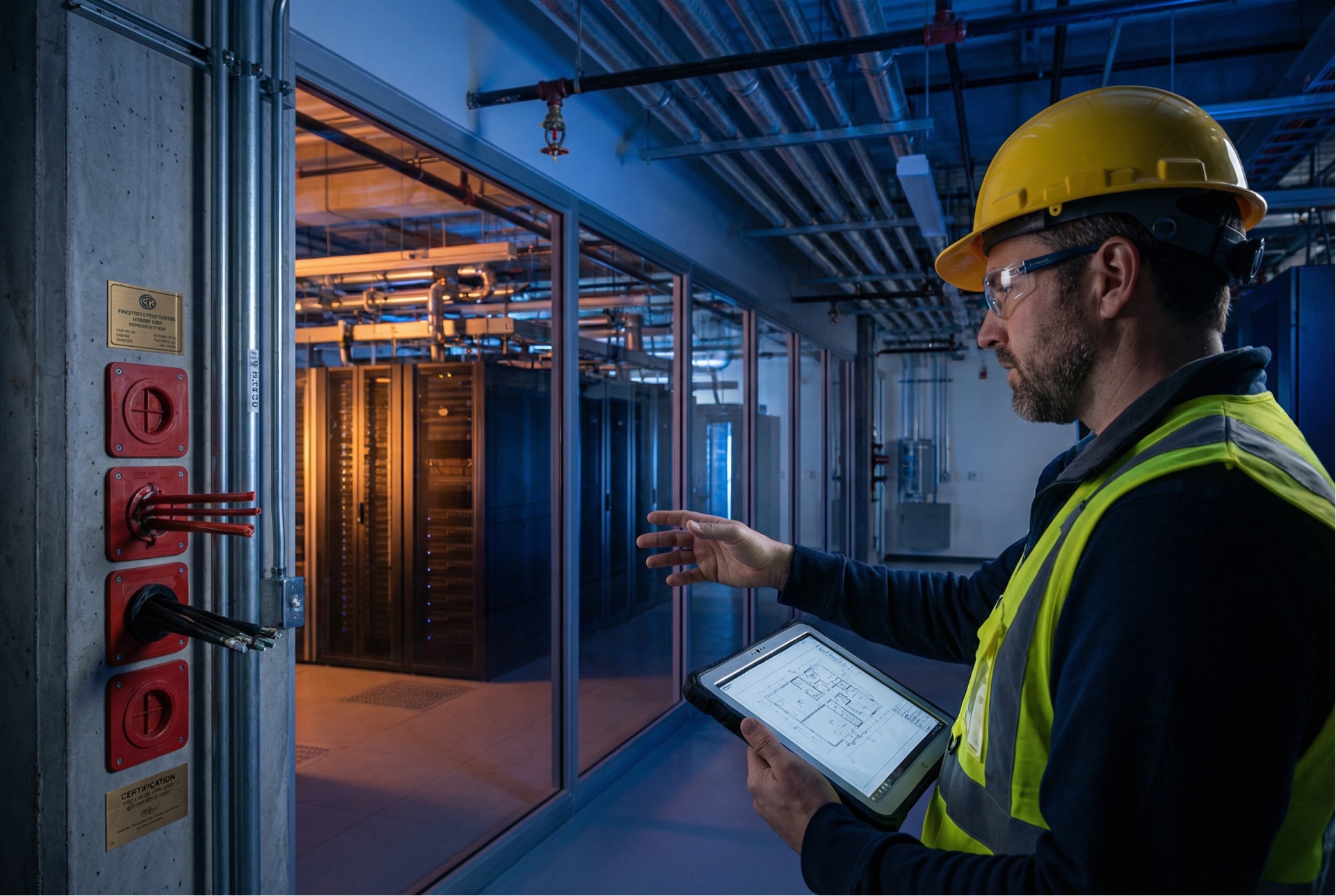

Why Do FM Data Sheets Require FM-Certified Firestop Contractors?
Why does the FM data sheet require an FM-certified firestop contractor?
In high-value industrial facilities such as data centers, semiconductor fabs, pharmaceutical plants, and energy facilities, firestopping is not a simple "patching" job. It is a critical measure to maintain the integrity of fire separations, control the spread of fire and smoke, and reduce the risk of property loss.
The FM data sheet system repeatedly emphasizes: firestopping should use FMApproved firestop systems and be installed by an FM4991-certified firestop contractor. The core reason is not just whether the materials are qualified, but whether the on-site installation result is truly reliable, auditable, and traceable.
Because the main risk of firestopping occurs on site Firestopping materials being certified only means the material or system demonstrates performance under specific test conditions.
But actual project sites are often more complex:
- Wall, floor, and fire separation constructions vary;
- Cable, tray, pipe, and duct penetrations vary in form;
- Opening sizes and the arrangement of penetrants vary;
- Installation depth, backing materials, and surface treatment requirements vary;
- Later additions such as new cabling, equipment modifications, or secondary openings may occur.
If the wrong system is selected, or the installation method deviates from the certified system requirements, even using certified materials may not achieve the expected fire protection performance.
Therefore, FM requires certified firestop contractors essentially to control the risk of on-site installation deviations.
Because firestopping is not a material issue but a system issue A reliable firestopping result requires simultaneously meeting:
correct materials + applicable system + correct installation + controlled process + traceable documentation
Purchasing only firestopping materials cannot guarantee that the on-site installation results meet FM’s risk control requirements.
The value of an FM4991-certified firestop contractor is that they can connect materials, systems, site conditions, and installation quality, ensuring firestopping is not simple stuffing but installed according to verifiable system requirements.
Because high-value facilities need an auditable chain of quality evidence For data centers, semiconductor fabs, pharmaceutical plants, and energy facilities, firestopping failure can cause more than local repair issues; it may lead to:
- Spread of fire and smoke;
- Damage to critical equipment;
- Production or operational interruptions;
- Contamination of clean areas;
- Impairment of gaseous suppression effectiveness;
- Insurance risk review issues.
Therefore, FM cares not only whether "firestopping was done," but also:
who did it, according to which system, how the site was controlled, whether documentation is complete, and whether it is traceable later.
This is precisely the importance of an FM4991-certified firestop contractor.
Can be paired with ILAC internationally accredited third-party inspection and airtightness testing For high-value industrial facilities, in addition to FM4991-certified contractor installation, services under the ILAC international accreditation framework can be added, including:
- Third-party firestopping inspection;
- Third-party airtightness testing;
- On-site sampling inspection;
- Defect rectification verification;
- Issuance of inspection and test reports.
Among these, third-party firestopping inspection can verify installation quality at penetrations, joints, trays, pipes, ducts, and other locations; third-party airtightness testing can be used for protected areas that use gaseous suppression systems such as data centers, UPS rooms, battery rooms, and control rooms to verify room integrity and agent retention capability.
This can form a more complete chain of quality evidence:
- FMApproved firestop systems
- FM4991-certified contractor installation
- ILAC internationally accredited third-party firestopping inspection
- ILAC internationally accredited third-party airtightness testing
Service positioning of Shanghai Tengxi Shanghai Tengxi Construction Engineering Co., Ltd. is an FM4991-certified firestop contractor focused on providing firestopping system selection, on-site installation control, quality record management, and documentation delivery services for high-value industrial facilities.
Services include:
- Selection of FMApproved firestop systems;
- FM4991-certified contractor installation;
- Pre-construction technical briefings;
- Material documentation and batch verification;
- Quantified management of penetration and joint locations;
- On-site construction photos and self-inspection records;
- Rectification closure and documentation delivery;
- Cooperation with ILAC internationally accredited third-party firestopping inspection;
- Cooperation with ILAC internationally accredited third-party airtightness testing.
Conclusion The core reason FM data sheets require an FM-certified firestop contractor is not the "certificate itself," but to control the risks of on-site installation, system applicability, later maintenance, and non-traceable documentation.
For high-value industrial sites such as data centers, semiconductor fabs, pharmaceutical plants, and energy facilities, it is recommended to establish the following chain of quality evidence:
- FMApproved firestop systems
- FM4991-certified contractor installation
- ILAC internationally accredited third-party firestopping inspection
- ILAC internationally accredited third-party airtightness testing
Firestopping is not just sealing openings; it is making fire separations truly capable of providing verifiable, auditable, and maintainable protection.
TKC — Science-based Industrial Safety & Protection
For more technical details or a professional assessment, please contact the TKC expert team.